


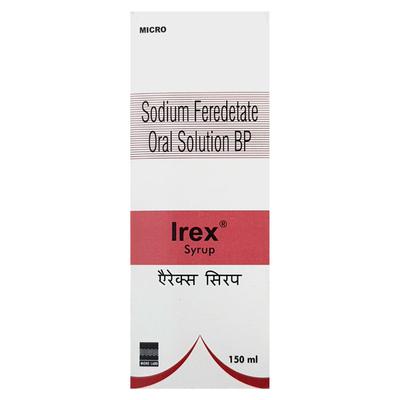


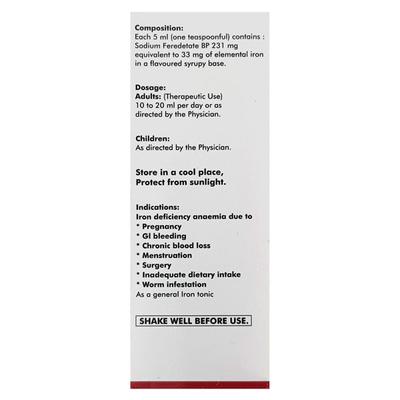
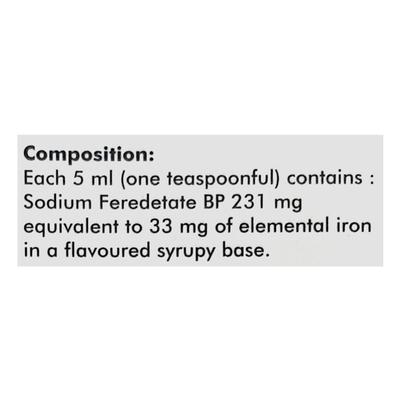
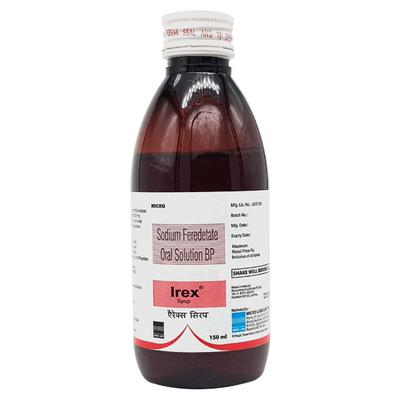

Irex Syrup 150ml

Netmeds First Membership
Quick Links
Introduction About IREX SYRUP
IREX SYRUP contains Sodium feredetate that belongs to the group of medicines called Hematinic agents. It is used to manage iron deficiency anemia in adults and a lower dose is used in pediatric patients to manage the same. Iron deficiency anemia is a condition in which the red blood cell count decreases abnormally due to deficiency of iron. It is characterized by symptoms such as fainting, paleness of the skin, fatigue, weakness, and shortness of breath.
IREX SYRUP is not recommended to be used in patients with have haemochromatosis (an inherited condition where iron levels slowly build up abnormally in the body) and hemosiderosis (a form of iron build-up, causing in the accumulation of hemosiderin which is an iron storage complex).
It is also not recommended for use if you are receiving repeated blood transfusions or parenteral iron therapy. It should be used with caution in patients with haemolytic anemia, iron-storage or iron-absorption diseases, existing gastrointestinal diseases, chronic liver disease or chronic kidney disease.
IREX SYRUP should be used with caution in pregnant women (especially in the first trimester) and breastfeeding women. It should be used with caution in children (below 24 months). Consult your doctor before taking it. The most common side effects associated with the use of IREX SYRUP are signs of allergic reactions (including rashes, itching, shortness of breath, and noisy breathing), mild diarrhoea, and nausea. Consult your doctor if any of the symptoms worsens.
Uses Of IREX SYRUP
- It is used to manage iron deficiency anemia
How IREX SYRUP Works
IREX SYRUP works by directly increasing the iron stores in the body, thereby increasing the synthesis of haemoglobin and myoglobin (oxygen carrying pigment in muscles).
How to use IREX SYRUP
Take IREX SYRUP as advised by your physician. It is for oral use only. Shake well before use. Your doctor will decide the correct dose and duration for you depending upon your age, body weight and disease condition.
Side Effects Of IREX SYRUP
Common
- signs of hypersensitivity (allergic reactions) such as rashes, itching, shortness of breath, and noisy breathing
- mild diarrhoea
- nausea
How To Manage Side Effects
Diarrhoea:
Drink lots of fluids, such as water to keep yourself hydrated. Try to avoid taking any medicine on your own to manage diarrhoea and consult your doctor if the symptom gets worse.
Nausea and vomiting:
Stick to simple meals. Avoid eating rich or spicy food. Consult your doctor if the symptom gets worse.
Warning & Precautions

Pregnancy
IREX SYRUP should be used with caution in pregnant women especially in the first trimester. Consult your doctor before taking it.

Breastfeeding
IREX SYRUP should be used with caution in breastfeeding women. Consult your doctor before taking it.

Kidney
IREX SYRUP is used with caution in patients with chronic kidney disease. Consult your doctor before taking it.

Liver
IREX SYRUP should be used with caution in patients with chronic liver disease. Consult your doctor before taking it.

Allergy
IREX SYRUP is not recommended for use if you are allergic to Sodium feredetate, or any other ingredients of this medicine. Consult your doctor before taking it.
Others
IREX SYRUP is not recommended for use if you:
- have haemochromatosis (an inherited condition where iron levels slowly build up abnormally in the body)
- have hemosiderosis (a form of iron build-up, causing in the accumulation of hemosiderin which is an iron storage complex)
- are receiving repeated blood transfusions
- are receiving parenteral iron therapy
Before taking IREX SYRUP, inform your doctor if you:
- have haemolytic anaemia (a condition in which blood cell destruction happens at an abnormally faster rate)
- have an iron-storage disorder
- have an iron-absorption disease
- have an existing gastrointestinal disease
- are scheduled for tests used for detection of occult blood in the stools
Use in Paediatrics:
IREX SYRUP should be used with caution in children (below 24 months). Prolonged or excessive use may lead to toxic accumulation. Consult your doctor before taking it.
Interactions
A. Drug-Drug Interactions:
Before taking IREX SYRUP, inform your doctor, if you are taking any of the following medicine:
- dimercaprol (medicine used to manage metal poisoning)
- penicillamine, tetracycline like doxycycline, fluoroquinolones like ciprofloxacin (medicine used to manage bacterial infections)
- mycophenolate (medicine used to lower the immune response of the body)
- medicines used to manage Parkinson’s disease (Ex. levodopa, carbidopa)
- medicine used to manage thyroid disorders (Ex. thyroxine)
- bisphosphonates (medicines used to lower bone loss) Ex. ibandronate
- methyldopa (medicine used to manage high blood pressure)
Overdosage:
If you or anyone else accidentally takes too much of IREX SYRUP, consult your doctor immediately or visit the nearby hospital.
Synopsis
| Drug | : | Sodium feredetate |
| Pharmacological Category | : | Hematinic agents |
| Therapeutic Indication | : | Iron deficiency anaemia |
| Dosage Forms | : | Syrup, Drops |
More Information
- Keep the medicine out of reach of children
- Store IREX SYRUP below 25°C
FAQs About IREX SYRUP
What IREX SYRUP is used for?
IREX SYRUP is used to manage iron deficiency anaemia which is a condition in which the red blood cell count decreases abnormally due to deficiency of iron. It is characterized by symptoms such as fainting, paleness of the skin, fatigue, weakness, and shortness of breath.
What side effects are seen with IREX SYRUP?
The most common side effects associated with the use of IREX SYRUP are signs of allergic reactions (including rashes, itching, shortness of breath, and noisy breathing), mild diarrhoea, and nausea. Consult your doctor if any of the symptoms worsen.
Who should avoid taking IREX SYRUP?
IREX SYRUP is not recommended for use if you are allergic to sodium feredetate. It is not recommended to be used in patients with have haemochromatosis (an inherited condition where iron levels slowly build up abnormally in the body), hemosiderosis (a form of iron build-up, causing in the accumulation of hemosiderin which is an iron storage complex). It is also not recommended to be used if you are receiving repeated blood transfusions or parenteral iron therapy.
How IREX SYRUP work?
IREX SYRUP contains sodium feredetate works by directly increasing the iron stores in the body, thereby enhancing the synthesis of haemoglobin and myoglobin (oxygen-carrying pigment in muscles).
Is IREX SYRUP safe to use in pregnancy and lactation?
IREX SYRUP should be used with caution in pregnant women, especially in the first trimester. It should also be used with caution in breastfeeding women. Consult your doctor.
Which medicines should be avoided while taking IREX SYRUP?
Avoid concomitant use of oral iron with dimercaprol (formation of toxic compounds). Iron reduces the absorption of penicillamine, fluoroquinolones, mycophenolate, levodopa, carbidopa, thyroxine, and bisphosphonates. Administration of oral iron may reduce the blood pressure-lowering effect of methyldopa. Iron and tetracyclines cause a reduction in the absorption of each other.
Is IREX SYRUP safe to use in patients with liver and kidney diseases?
IREX SYRUP should be used with caution in patients with chronic liver disease (long-standing diseases causing liver impairment) or chronic kidney disease (long standing diseases causing kidney impairment). Consult your doctor before taking it.
References
1. Kanan Yelikar. Drugs in Obstetrics & Gynecology. Practical Cases in Obstetrics & Gynecology. 2015. Page – 93.
2. Eleana Gkamprela, Melanie Deutsch, Dimitrios Pectasides. Iron deficiency anemia in chronic liver disease: etiopathogenesis, diagnosis and treatment. NIH National Library of Medicine. National Centre for Biotechnology Information. PMC PubMed Central. May 2017. [Assessed on 14th September 2022] https://www.ncbi.nlm.nih.gov/pmc/articles/PMC5479992/
3. Marcel Adler, Francisco Herrera-Gómez, Débora Martín-García, Marie Gavid, F. Javier Álvarez, Carlos Ochoa-Sangrador. The Impact of Iron Supplementation for Treating Anemia in Patients with Chronic Kidney Disease: Results from Pairwise and Network Meta-Analyses of Randomized Controlled Trials. NIH National Library of Medicine. National Centre for Biotechnology Information. PMC PubMed Central. April 2020. [Assessed on 14th September 2022] https://www.ncbi.nlm.nih.gov/pmc/articles/PMC7281268/
4. Carel Theo Jozef Wreesmann. Reasons for raising the maximum acceptable daily intake of EDTA and the benefits for iron fortification of foods for children 6–24 months of age. NIH National Library of Medicine. National Centre for Biotechnology Information. PMC PubMed Central. October 2014. [Assessed on 14th September 2022] https://www.ncbi.nlm.nih.gov/pmc/articles/PMC4282355/
5. Micro Labs Ltd. Irex Syrup (Sodium Feredetate ). [Assessed on 14th September 2022 http://www.microlabsltd.com/elibrary/node/1546
6. Ravenbhel Pharma. Sfe drops (Sodium Feredetate). [Assessed on 14th September 2022] https://www.ravenbhelpharma.com/Products?i==5&x=Paediatrics
Useful Diagnostic Tests
- Complete blood tests
Author Details